The Witch's Bakery gameplay: Daily Life Explained
Explore The Witch's Bakery gameplay, from serving customers and exploring Paris to Heart Palaces, magic upgrades, and practical beginner tips.
What Is The Witch's Bakery Gameplay Like?
A croissant can do more than brighten someone’s morning when its baker can see into their heart. The Witch's Bakery gameplay combines running a Parisian bakery with exploring the city and helping people through emotional struggles, making its story focus important to understand before buying. If you’re wondering whether this is a detailed business simulator or a character-driven adventure, this guide to The Witch's Bakery gameplay explains the daily routine, magical encounters, and expectations worth setting.
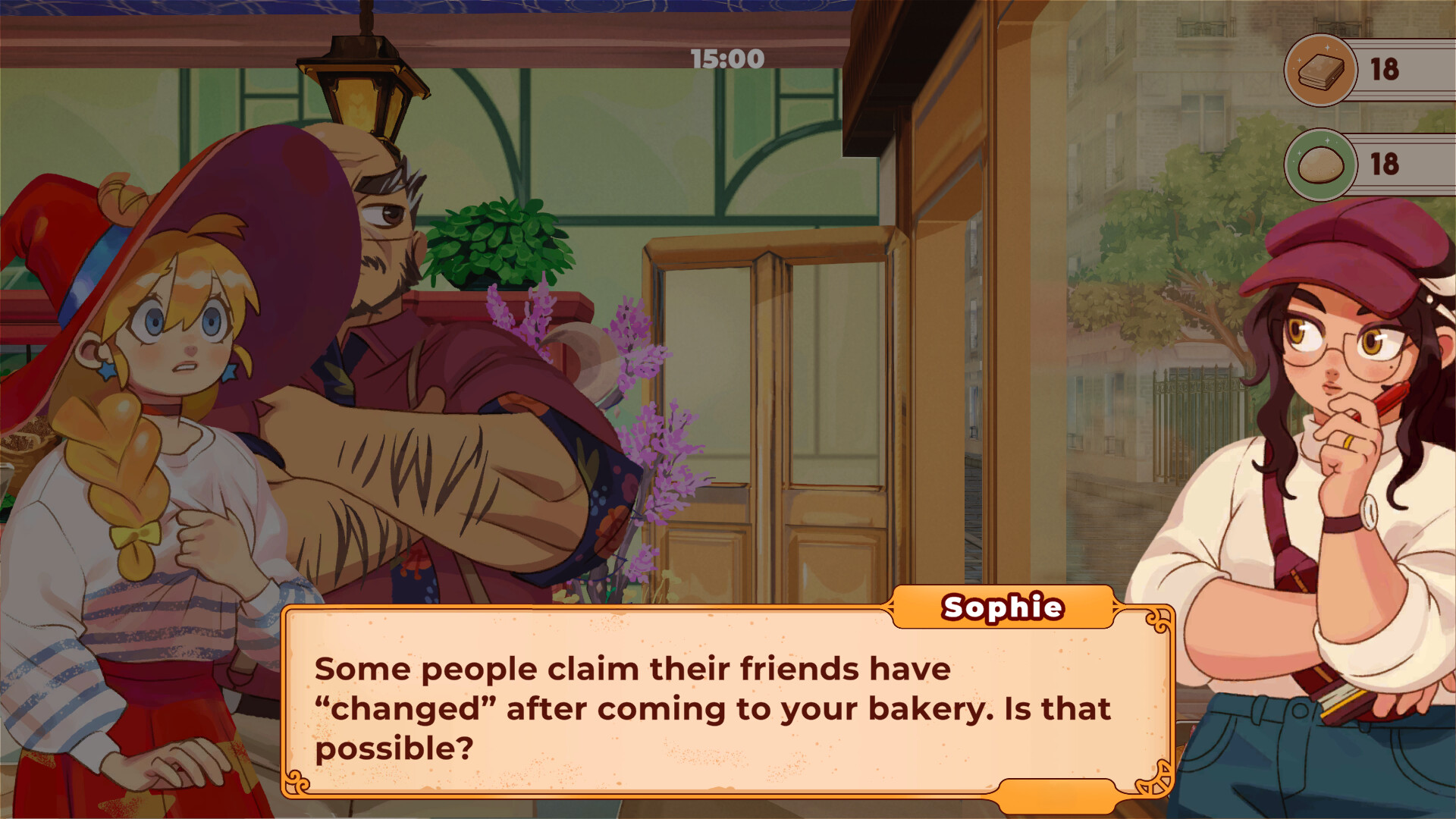
Official screenshot · Source: Steam store
Developed by Sunny Lab and published by Silver Lining Interactive, the game follows Lunne, a witch who has recently arrived in modern Paris. Her bakery provides a livelihood, but her unusual gift gives her another purpose: understanding people’s emotions and using magic-infused baking to help them.
The official description positions it as a 2D narrative adventure RPG, not solely a cooking game. Baking, conversations, neighborhood visits, and magical emotional journeys all contribute to the experience.
The essentials at a glance
| Feature | What to expect |
|---|---|
| Main character | Lunne, a witch opening a bakery in Paris |
| Core structure | Repeating daytime, evening, and nighttime phases |
| Bakery role | Serving customers and helping them through their troubles |
| Exploration | Several Paris districts with characters, shops, and activities |
| Magical feature | Entering Heart Palaces to help people with deeply buried emotions |
| Progression | Experience, money, fame, relationships, and magical improvement |
| Steam release | October 14, 2026 |
| Play format | Single-player |
As of October 20, 2026, the supplied Steam listing shows a Very Positive rating, with 94% of 219 qualifying user reviews marked positive. That is an encouraging early snapshot, not a guarantee that its particular balance of story and bakery work will suit everyone.
You can check current pricing, compatibility, trailers, and updates on the official The Witch’s Bakery Steam page.
The Daily Loop: Bake, Explore, and Recharge
The easiest way to understand The Witch's Bakery gameplay is to follow Lunne through a complete day. Rather than keeping you behind the counter indefinitely, the game divides daily life into three distinct phases.
Each phase supports a different part of the fantasy: working as a baker, becoming part of a neighborhood, and maintaining a magical home life.
| Daily phase | Main activities | What to pay attention to |
|---|---|---|
| Daytime | Work in the bakery and help customers | Customer interactions and the bakery routine |
| Evening | Explore Paris, build relationships, and enter troubled hearts | Character stories, shops, activities, and discoveries |
| Night | Rest, improve magic, decorate, and spend time in the atelier | Available improvements and personalizing your space |
Daytime: the bakery is your starting point
During the day, Lunne works in her shop and assists customers with a little magic. This establishes the connection between ordinary business and the game’s emotional storytelling.
However, the available material does not establish a detailed simulation of ingredient purchasing, production forecasting, or pricing strategy. If those are your favorite parts of management games, avoid assuming they are the central attraction here.
Practical tip: Use the opening bakery sessions to learn the interaction prompts and rhythm before deciding how demanding the shop work feels. The “cozy” label describes the broader tone; it does not necessarily mean every individual interaction is completely unhurried.
Evening: Paris becomes part of the adventure
After work, Lunne can visit different districts, meet important characters, and participate in activities that help her get to know them.
Exploration also connects back to baking. The official description specifically mentions buying books that provide new recipes, giving neighborhood visits a practical purpose alongside their storytelling role.
Practical tip: Treat shops and conversations as part of progression rather than distractions from it. A recipe book or character activity may be more relevant to your experience than another piece of bakery decoration.
Night: a quieter, personal phase
At night, Lunne rests, improves her magic, decorates the bakery, and spends time in her atelier. This is the home-life side of the daily loop.
The reference material does not specify upgrade costs or an optimal improvement order. A sensible approach is to read each available option carefully and decide whether you want to prioritize magical development or the appearance of your space.
Baking Mechanics: Story Adventure or Management Sim?
One of the most useful questions about The Witch's Bakery gameplay is not whether it contains baking, but what role baking plays.
The official presentation emphasizes characters, emotional healing, and Parisian exploration. That makes a story-led adventure the safer expectation than an open-ended bakery business sandbox.
What early player experience tells us
In a Steam discussion about the demo, one player described the bakery segment as resembling a time-management activity, with keyboard inputs rather than hands-on ingredient measurement. They wanted more supply-and-demand decisions and felt the baking portion ended too quickly.
Another player questioned the apparent linearity and replay incentive. These are player experience reports about the demo, not confirmed descriptions of every system in the released game.
A developer representative responded that the full experience emphasizes exploring Paris and its characters’ stories. That clarification helps explain the intended focus without proving that every concern raised about the demo carried over—or was resolved.
| Expectation | What the references support |
|---|---|
| A character-driven adventure | A major focus of the official description |
| Bakery interactions with timed or rapid inputs | Described in demo player experience |
| Detailed dough measurement | Requested by a demo player, not established as a feature |
| A deep supply-and-demand economy | Desired in community feedback, not confirmed |
| Conversations and relationship building | Explicitly included in the official daily loop |
| Unlimited sandbox replayability | Not established by the available material |
How to judge whether the balance suits you
When watching gameplay footage, look beyond attractive pastries and colorful streets. Check how much time is spent on dialogue, bakery inputs, walking, and character activities.
Ask yourself:
- Do I enjoy conversations as a main activity?
- Am I happy with bakery work sharing time with a larger story?
- Does exploring characters’ problems sound rewarding?
- Would I miss complex inventory, pricing, and production decisions?
Those questions are more useful than relying on the word “cozy.” The Witch's Bakery gameplay may appeal to someone seeking emotional storytelling for exactly the reasons it disappoints someone seeking intensive business management.
Heart Palaces, Relationships, and Exploring Paris
The most distinctive part of Lunne’s magic is her ability to enter a Heart Palace. These are magical spaces where a person’s thoughts and emotions take physical form.
Some emotional struggles are too deeply locked away for Lunne to address from the outside. Inside a Heart Palace, she must guide a personified Emotion back to the Heart’s Cradle and discover an important ingredient for healing bread.
How the emotional-healing process connects
| Stage | What happens | Why it matters |
|---|---|---|
| Learn about someone | Lunne develops relationships and encounters personal struggles | Establishes the character’s emotional context |
| Enter a Heart Palace | Thoughts and emotions become tangible | Turns an internal struggle into an explorable space |
| Guide the Emotion | Lunne leads it toward the Heart’s Cradle | Gives the magical encounter a specific objective |
| Discover the ingredient | Lunne finds what she needs for healing bread | Connects emotional understanding with baking |
| Make healing bread | Her baking becomes a vehicle for magical help | Brings the bakery and narrative systems together |
That connection gives The Witch's Bakery gameplay a clearer identity than simply “a cooking game with spells.” The bakery is part of how Lunne responds to what she learns about people.
The available sources do not establish exact puzzle mechanics, combat rules, or difficulty settings for Heart Palaces. There is no reason to assume they function like traditional RPG combat dungeons.
Paris is more than a backdrop
The official description promises several districts, each with its own characters, activities, and shops. One highlighted location is Le Quai des Bouquinistes, associated with the city’s riverside booksellers.
This supports a neighborhood-based adventure rather than confirming a seamless, unrestricted open world.
Practical tip: Approach evening exploration with a small goal: get to know a character, investigate a shop, or look for recipe books. That keeps city visits connected to your interests without turning every outing into a checklist.
Relationships are also worth approaching for their stories, not merely as another resource to maximize. Understanding the people around Lunne is central to the game’s premise.
Beginner Tips and Technical Details Worth Knowing
Getting comfortable with The Witch's Bakery gameplay starts with matching your habits to its daily structure. You do not need an elaborate optimization plan, but a few checks can prevent avoidable frustration.
Five useful starting habits
- Learn the full daily cycle before judging the balance. Bakery work is only one portion of the experience; exploration and nighttime activities complete the intended routine.
- Read recipe-book descriptions. The official material identifies books as a source of new recipes, making them worth checking while shopping.
- Try clicking to speed up dialogue. A developer representative recommended this in response to demo feedback about text speed.
- Review recent announcements if you played the demo. The Steam listing includes an October 15 notice specifically directed at returning demo players. Read the full notice rather than guessing what needs changing.
- Check updates if pursuing Estelle’s romance. An announcement says a relevant fix went live October 19. Players with affected saves should consult the complete instructions.
PC requirements and handheld support
| Component | Minimum | Recommended |
|---|---|---|
| Operating system | Windows 10 or higher, 64-bit | Windows 10 or higher, 64-bit |
| Processor | AMD Athlon X4 or Intel Core i5-4460 | AMD Ryzen 3 or Intel i5 Skylake |
| Memory | 8 GB RAM | 8 GB RAM |
| Graphics | Nvidia GTX 950 or AMD R7 370 | Nvidia GTX 970 or AMD RX 570 |
| DirectX | Version 11 | Version 11 |
| Available storage | 20 GB | 20 GB |
The supplied Steam listing marks the game Steam Deck Verified and lists support for Xbox and PlayStation controllers. It also includes Steam Cloud and 60 achievements.
For buyers, the listed regular U.S. price is $19.99. As of October 20, the introductory offer reduces it to $17.99 through October 28. Pricing and promotions can change, so confirm before purchasing.
Ultimately, the strongest reason to consider this game is its combination of a recurring daily routine and emotionally focused adventure—not an expectation of exhaustive bakery economics.
FAQ: The Witch’s Bakery Gameplay
Is The Witch's Bakery gameplay mainly baking or storytelling?
It combines both, but the official description emphasizes a narrative adventure. Bakery work occupies the daytime phase, while exploring Paris, building relationships, entering Heart Palaces, and improving magic fill out the broader experience.
Is The Witch’s Bakery a detailed management simulator?
The available references do not establish deep inventory, supply-chain, or pricing systems. Demo player experience describes time-management-style bakery interactions, but that feedback should not be treated as a complete assessment of the released game.
What do you do inside a Heart Palace?
Lunne enters a magical representation of someone’s inner world, guides a personified Emotion back to the Heart’s Cradle, and discovers a key ingredient used to make healing bread. These sequences connect character development with her magical baking.
Can you play The Witch’s Bakery on Steam Deck?
Yes. As of October 20, 2026, the supplied Steam listing marks it Steam Deck Verified. The listing also includes controller support and Steam Cloud, useful features if you plan to move between a desktop PC and handheld play.
Related Guides
The Witch's Bakery demo playthrough: Gameplay Guide
Explore The Witch's Bakery demo playthrough with baking tips, Heart Palace puzzles, Paris activities, and a clear look at early gameplay.
The Witch's Bakery first impressions: Cozy Magic
The Witch's Bakery first impressions explore cozy baking, Heart Palace stories, Parisian charm, and demo feedback to help you decide if it fits.
The Witch's Bakery launch trailer: Switch Release
The Witch's Bakery launch trailer arrives as the cozy RPG releases on Switch 2 and Switch. Explore its Paris setting, daily routine, and healing magic.
The Witch's Bakery delayed: New Date and Launch Guide
The Witch's Bakery delayed its August launch to October 14. Learn why, which platforms were announced, and what to check before buying.
The Witch's Bakery Switch: Price, Editions & Gameplay
Explore The Witch's Bakery Switch release dates, pricing, physical editions, Switch 2 details, gameplay, and practical tips before buying.